


The Civilization Of The Renaissance In Italy
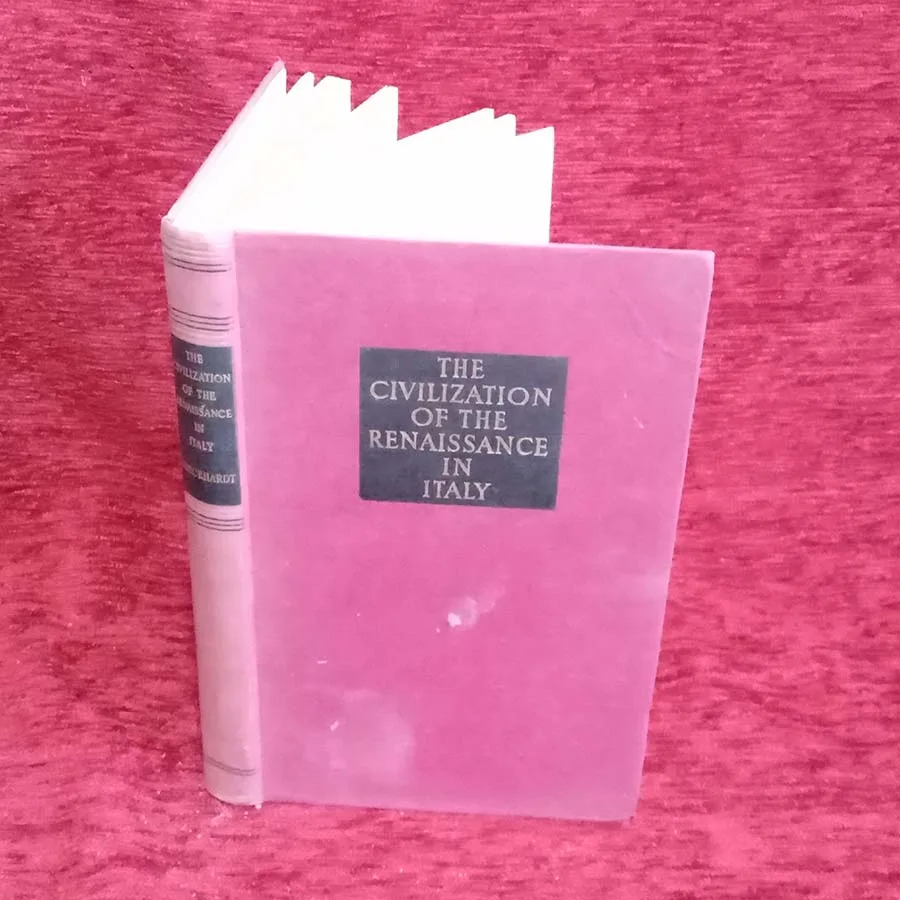
Publisher: Phaidon Press
Format: Hardback
ISBN: none
There are history books, and then there are books that stride in, look at an entire civilisation, and announce that they intend to explain how modern individuality, politics, art, culture, spectacle, cruelty, refinement and self-conscious brilliance all exploded into life in Renaissance Italy. The Civilization of the Renaissance in Italy is very much one of the latter. Jacob Burckhardt’s great work is not so much a modest study as a full-dress intellectual performance, one that has spent generations convincing readers that if they want to understand why Europe became gloriously clever, vain, artistic and dangerous, they had better start in Italy.
This 1944 Phaidon Press edition brings with it all the gravitas one could wish for. It is a book from the middle of the twentieth century about a nineteenth-century historian interpreting the fifteenth and sixteenth centuries, which means it already contains several layers of civilisation before you have even opened it. Burckhardt’s subject is the Renaissance, but his real fascination lies in the emergence of the modern self: the moment when men in doublets and ambitious city-states began behaving as though politics, beauty, power and personal glory might all be pursued at once, preferably in beautifully frescoed surroundings.
What makes Burckhardt so enduring is that he was not content to give a dry chronological account of rulers, wars and treaties. He wanted to capture a whole atmosphere: the courts, the despots, the artists, the scholars, the conspiracies, the splendour, the violence, the rediscovery of antiquity, the cultivation of style, and the intoxicating sense that human beings had suddenly remembered they could make themselves extraordinary. He sees the Renaissance not merely as a period, but as a transformation in consciousness. Which is an ambitious thing to claim, but then ambition is very much the subject here.
And what a subject it is. Renaissance Italy remains one of history’s most irresistible spectacles: a place where bankers commissioned masterpieces, princes arranged murders with aesthetic flair, scholars rediscovered the ancient world with almost indecent enthusiasm, and city-states competed to see who could produce the finest architecture while also betraying one another politically. Burckhardt understands that this mixture of brilliance and moral instability is precisely what gives the era its charge. Civilisation, in his telling, is not a tidy process. It is dazzling, cultivated, ruthless and frequently alarming.
There is something wonderfully ironic about the title too. “Civilization” sounds so calm, so settled, so proper. Yet the civilisation Burckhardt describes is full of swagger, display, intellectual upheaval and magnificently self-aware human beings behaving in ways that are by turns admirable, theatrical and faintly terrifying. It is civilisation with a taste for magnificence and a knife behind the tapestry. Which, when one thinks about it, may be the most memorable sort.
This 1944 Phaidon Press edition has the added charm of wartime-era solidity. It comes from a moment when publishers still believed in making serious books that looked serious, and when readers could be trusted to tackle a substantial work of cultural history without needing any promises of simplification or cheerful bullet points. The result is a handsome, compact hardback with real presence. It looks like the sort of book that expects to be taken seriously, and rewards the effort.
In Good condition, this copy has survived rather well. The image suggests a neat, attractive volume with the quiet dignity of a book that has spent decades being more learned than most of the room. It has that pleasing old-book authority which suits Burckhardt perfectly. This is not a text that benefits from flimsy modern packaging or overexcited design. It wants a proper binding, a proper shelf, and a reader prepared to meet it halfway.
For the modern reader, the book remains fascinating not only because of its subject but because of Burckhardt himself. Some of his arguments have been debated, qualified and revised by later historians, as is the fate of all influential scholarship. But that scarcely diminishes the force of the work. It is one of those rare historical books that changed how people imagined an entire age. Even when one disagrees, one does so in the presence of a very large mind making very large claims, and that is part of the pleasure.
As a Crappy Old Books item, it is exactly the right kind of treasure: scholarly, elegant, culturally ambitious, and full of the pleasures of old intellectual confidence. It will appeal to readers of Renaissance history, lovers of art and Italy, collectors of classic historical works, and anyone who enjoys books that feel as though they were written under the assumption that culture matters enormously and ought to be discussed at length.
In short, The Civilization of the Renaissance in Italy is one of the great monuments of cultural history: grand, provocative, rich in insight, and entirely unafraid of sweeping conclusions. This 1944 Phaidon Press copy, in Good condition, is a fine Crappy Old Books survivor from the age when serious history still expected to be both learned and literary. A splendid volume for anyone who likes their civilisation brilliant, their scholarship authoritative, and their Italy full of art, ambition and beautifully organised chaos.
Keep browsing: See more History books Other books by Jacob Burckhardt
